Name: EV INSURANCE
Type: USER RESEARCH
Duration: SPRING/SUMMER2018
Executive summary
This project explored how electric vehicle (EV) owners perceive and relate insurance to EV ownership, using exploratory research to uncover where uncertainty, friction, and unmet expectations arise and how these insights informed the development of a dedicated EV insurance product.

Design challenge
Insurance rarely plays a role when customers choose an electric car. For most EV owners, the decision is driven by range, charging convenience, price, and everyday usability. Insurance only becomes relevant later in the journey, where it often feels complex and unexpectedly difficult to navigate.
The core challenge was to understand:
- How EV owners mentally connect their car with insurance
- When insurance becomes relevant in the EV customer journey
- What creates trust vs. frustration
- How topics like pricing, risk, and coverage can be made easier to understand
Design solution
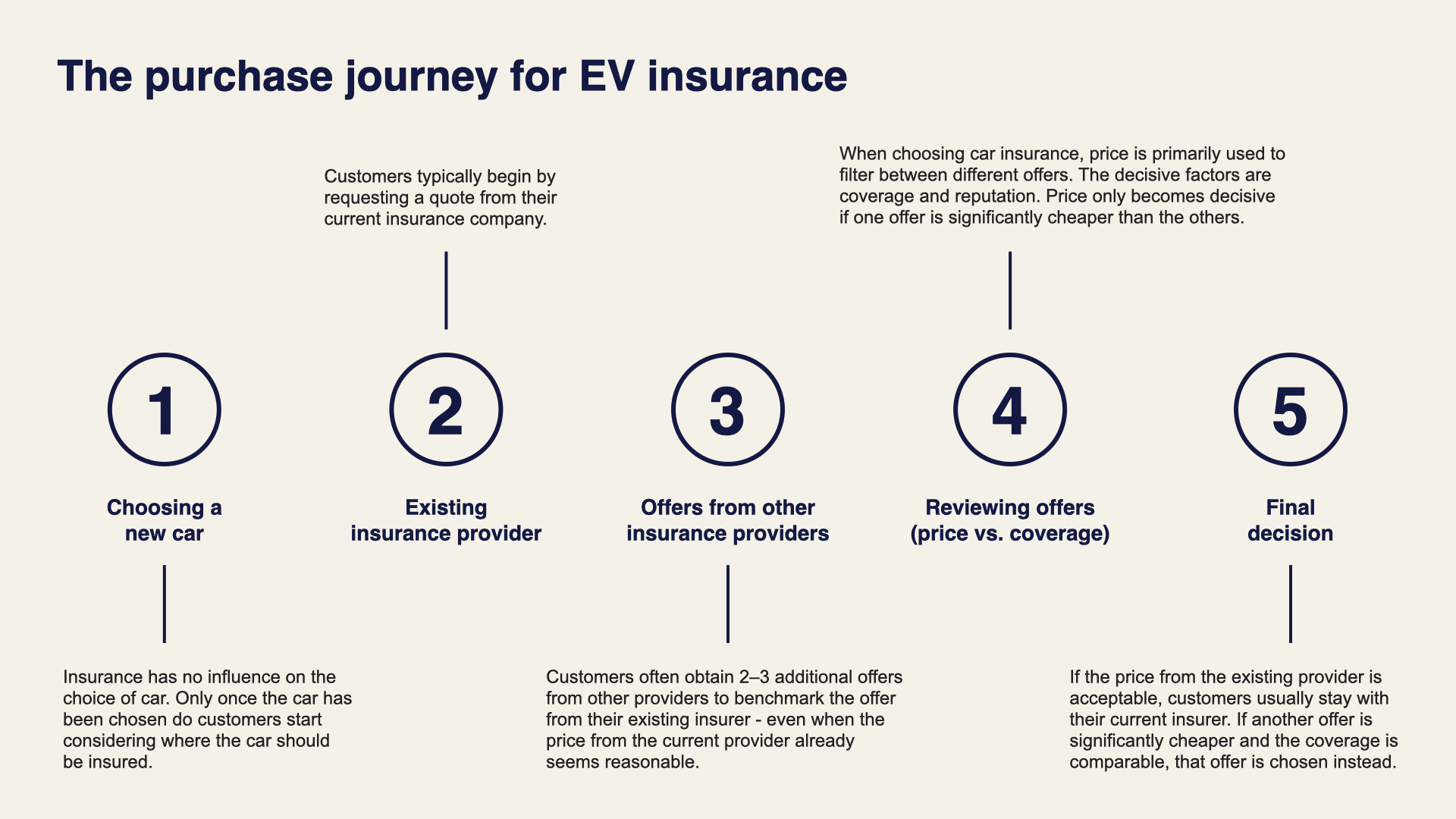
A key outcome of the research was a shift in perspective: EV insurance was not failing because of missing features, but because it was designed around internal logic rather than how customers think about EV ownership. Rather than pointing to missing functionality, the insights reframed how EV insurance should be understood and discussed across product development. The following key insights emerged from the research:
Insurance is a hygiene factor: Insurance rarely influences the choice of an electric car, but becomes critical once the car has been chosen. At that point, it is expected to work seamlessly as part of ownership rather than stand out as a separate product.
Price works as a filter: Price is mainly used to rule out options that feel disproportionately expensive. After this initial filtering, customers base their decision on coverage clarity and trust in the provider rather than on price alone.
EV-specific elements are assumed, not understood: Batteries, charging cables, and home chargers are generally expected to be covered by default. Few customers understand how this coverage actually works, creating a gap between expectations and reality.
Clear explanations reduce friction: Explaining EV-specific differences does not overwhelm customers. On the contrary, clear and concrete explanations increase confidence and trust, especially in conversations about price and coverage.
As a result, stakeholder discussions shifted from optimising product features to clarifying expectations, particularly around EV-specific coverage and pricing, ensuring that product decisions were grounded in how customers actually reason about EV ownership.
Process / Impact
The project was driven by qualitative research, combining in-depth interviews with EV owners and analysis of customer service calls related to electric vehicles. The aim was to understand how customers think about EV insurance in practice, and where uncertainty and friction arise when insurance becomes relevant.
Qualitative interviews
I conducted qualitative interviews with electric vehicle owners, focusing on their car purchase journey and how insurance fits into that journey. The interviews were designed to uncover priorities, expectations, and trade-offs rather than surface-level opinions.
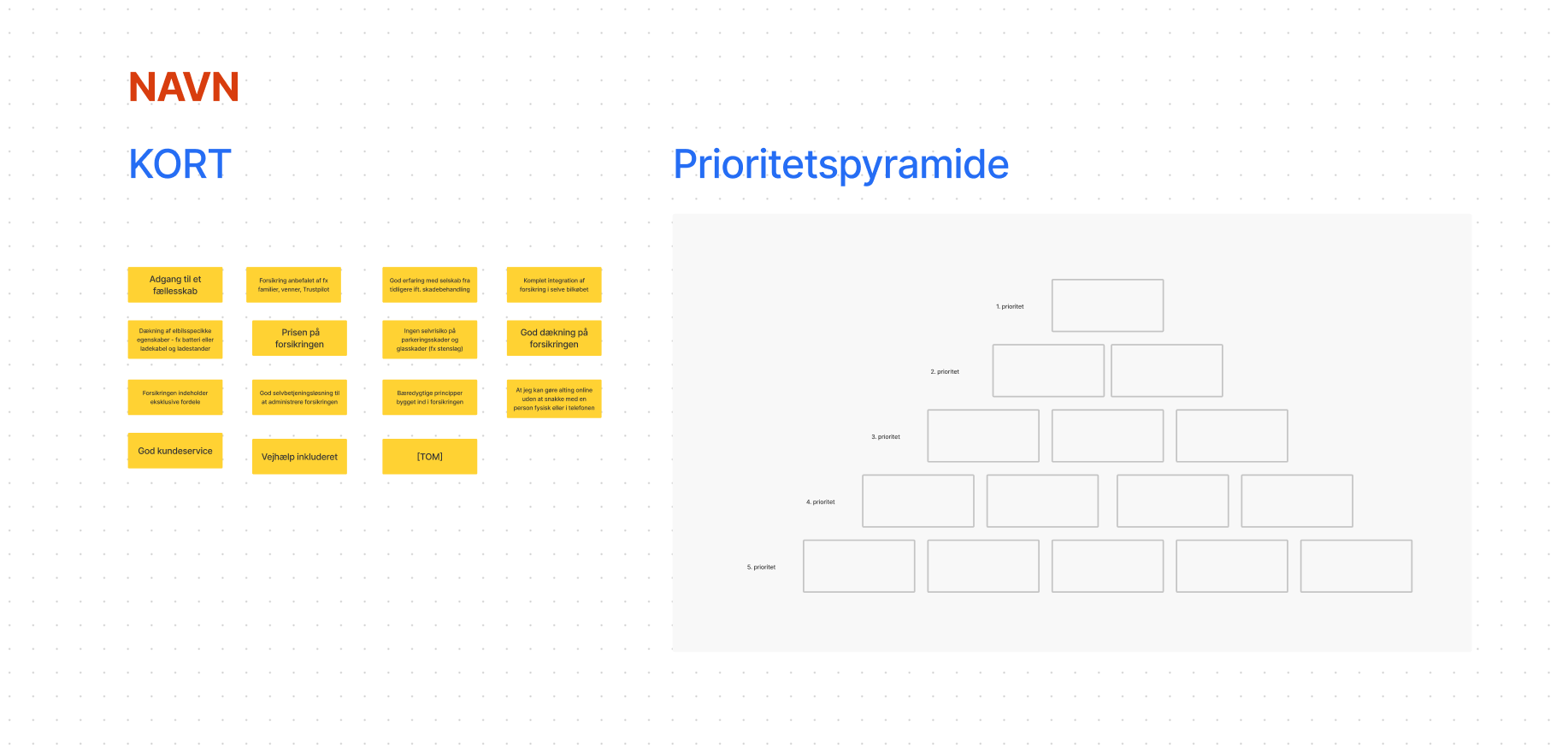
The priority pyramid
A central element of the interviews was a priority pyramid exercise, which asked participants to prioritise insurance parameters by making explicit trade-offs between factors such as price, coverage, trust, and convenience.
By forcing these choices, the exercise moved conversations from abstract preferences to concrete decision-making and revealed clear gaps between what customers initially claimed was important and what ultimately drove their choices.
The exercise revealed clear gaps between what customers initially claimed was important and what they prioritised when forced to choose, and played a key role in uncovering how price functions as a filter rather than a final decision driver.
Customer service call analysis
To complement the interviews, I analysed customer service calls related to EV insurance. These calls provided insight into real moments of confusion, negotiation, and expectation-setting, especially around price and EV-specific coverage, and helped validate and nuance the interview findings.
Other projects
Market OverviewWebsite Design

EV InsuranceUser Research
Topdanmark AppApp Design
Onboard non-investorsDigital Strategy

Behaviour typesUser Research
Nordea MobileApp Design
Flow - connecting fast money and slow moneyDigital Strategy